Blog 17
Telling The Rocky Brook Story Through Time and Change (Part Two)

How long have salmon been going up the Dosewallips River and Rocky Brook? Thinking about this makes me also ask, “How long has, what I call “Rocky Brook” even been here?”
A useful way to think about what I am calling “long time”, the millions and even billions of years that the earth has been in existence, is to compare it to a human year. Thus, imagine that the earth began forming on January 1 at 12:01 am, and today is December 31st, 11:59 pm. This means that all of earth’s, geologic, salmon and human history happens in one year. Here is how it works.
January (about 4.5 to 4.1 billion years ago)
Planetesimals
The earth is taking shape. Rocky Brook, salmon and us humans do not exist in any way, shape or form, (though maybe in the “Great Mind of Some Creative Force” which we cannot even imagine … or “God” which seems to be easier to picture for many humans).

In a relatively small, not particularly significant part of the Universe, an interstellar cloud collapses, resulting in the formation of the sun. Nothing much out to the ordinary here, this kind of thing happens on a regular basis out there amongst the billions of stars. The emerging sun is surrounded by a swirling disk of interstellar gas and dust. The swirling of these clouds created both the rotational motion of the planets around the sun and their own rotations. Gravity draws these materials together, forming what are called planetesimals. They continue to enlarge and solidify as more and more of the materials around them are pulled in. The larger planetesimals, those that are able to attract the most material become the planets. Earth is one of them. This all takes place during the first half billion years (roughly the whole month of January in this analogy).
Like the sun, the earth is hot inside, molten, though it is believed that, unlike the sun, this heating happened over time. Our planet’s molten core is the result of reactions of radioactive elements incorporated into its minerals, releasing great heat. This molten material became the source of all the surface mountains, oceans, forests … and salmon. But that all came later, much, much, much later as we will see.

As the inside of the earth became hot, materials moved about, the heavy stuff to the center, forming the core, and the lighter stuff rose towards the surface. This resulted in three general areas, the outer crust (where Rocky Brook and everyplace else we usually think about, is found), the mantle (most of the earth’s interior, solid but hot, and the core (hot liquid surrounding what is thought to be solid iron).
Initially the young earth was a searing, lifeless landscape of rock. As the “cloud of debris” out of which earth and the other planets cleared, undoubtedly meteorites, asteroids, and other materials crashed into the surface way more frequently than during later times. The surface probably looked much like the moon, pock-marked with numerous craters. The heat meant that there was not much water, none on the surface, maybe some vapor in the young atmosphere.
The “place” I call Rocky Brook existed, though only as a theoretical point on the surface of a giant sphere. It’s location (map coordinates) are 47.7214 north latitude and -122.94169 west longitude.
February (about 4.1 to 3.7 billion years ago)
Migration Into Place
The earth-forming processes continue. As the clouds of atoms solidify into rock, the early atmosphere is being formed by volcanic activity, where hot gasses are spewed out. The “air” above the surface was probably like that of Venus today; mostly carbon dioxide, some water vapor ( beginnings of shallow seas), nitrogen, and only a trace of oxygen, not nearly enough to breathe or support life.
By now the earth is pretty much the size it will be, yet it is still not in its final location, This period is when it and the other emerging planets and moons assume their locations orbiting around the sun. It is characterized by craters from colliding asteroids, meteors, and other debris as well as canyons, volcanoes and wind-swept plains. Water may have come from asteroid collisions, though the surface is too hot for it to be liquid.

All the building blocks of later life were present: elements derived from the atmosphere and volcanic activity. Just as the laws of physics guided the geologic processes resulting in the formation of the planet, so to the laws of chemistry dictated that the atoms and molecules present combined, broke apart, and combined anew, over and over and over again, for millions of years.
Rocky Brook, like most of the surface of the planet, was still a hot, dry, lifeless place, with earthquakes, volcanic eruptions, lightning, extreme winds, intense sunlight, and acidic rainstorms.
March (about 3.7 to 3.3 billion years ago)
Things Are Starting To Look Familiar
By now, earth-forming process have created the solid, spherical, rotating orb we are familiar with. The oldest known rocks (referred to as “Acasta gneiss” in what is now Canada) appear at the surface. It is still an alien world of acid rain, volcanic eruptions, storms, and intense heat. Water was released by volcanic activity into the young atmosphere where it condensed into rain and began to collect in lower areas, forming shallow seas. Wind and rain began the process of transforming the surface rock, wearing it away, transporting it downslope where it collected. There were no soils yet since there was no life. The landscape had steep slopes initially, as the weathering, wearing down processes were just beginning.
The winds and rains and gravity which were breaking down rock on the surface however could not keep up with the earth’s internal energy which kept pushing more material up through volcanic activity and the constant shifting, pushing and uplifting of the young planet’s crustal areas. What we used to call “continental drift” and now refer to as plate tectonics was probably far more active back then, resulting in more frequent earthquakes and associated surface changes, though at a geologic rather than human scale. There were probably hundreds, even thousands of years when things in certain places changed little.
We can only guess what Rocky Brook was like, either a barren, hot and dry moonscape, or possibly covered by a chemical rich water in a shallow sea … where what we call life might be about to begin. We are a quarter of the way through our planet’s history and a long long way from anything even resembling a salmon existing.
April (about 3.3 to 2.9 billion years ago)
Simple Life Emerges
Scientists believe that what we call “life” emerged around this time. Biological life required two things; the ability to absorb energy from the surroundings, and a way to replicate or reproduce.
The materials necessary for life existed in abundance in the air and surface water; ammonia, methane, hydrogen, water vapor, carbon dioxide. These had began to combine and recombine in myriad ways due to their chemical characteristics. Electrical energy through lightening and/or intense sunlight provided the spark. This energy broke the chemical bonds and allowed the formation of new substances, such as amino acids, which are considered to be fundamental building blocks of life as we know it.
The shallow seas that were resulting from more water vapor being spewed up by the near constant volcanic activity, saw the gradual build-up of fats, sugars, amino acids and proteins. This became what is commonly referred to as the “primordial soup”. Eventually, the combining and fusing formed nucleic acids some of which became encased by early proto-proteins, the harbingers of single celled organisms … bacteria and algae.
It took millions and millions of years and billions and billions of molecules combining and recombining for all this to happen.
Rocky Brook may have been in a shallow sea where some of this early life forming processes were occurring … or it may have still been dry, inhospitable land; we may never know for sure.
May (about 2.9 to 2.6 billion years ago)
Primordial Soup in Shallow Seas
By this time the chemical soup had created the first plant-like creatures, especially blue-green algae. We know this because the earliest discovered fossils, fossilized plant remains resembling today’s blue-green algae date from this period. Somehow it had “learned” to capture sunlight, make the molecules that it needed to grow, and then to replicate itself. Eventually, the shallow seas would be filled with them, and, through little variations, would evolve into other simple living forms. All these emerging life forms lived in water, the land was still too inhospitable to support any kind of life there.
The surface of the earth continued to change as volcanoes spewed up molten rock from within, rain and wind and gravity wore down rock found on the surface and collected in lower areas to form shallow seas, and plates floating on mantle’s molten rock shifted, rode over or slipped under one another. One can only guess as to what kind of place Rocky Brook was during this time.
June and July (about 2.6 to 1.8 billion years ago)
Life Continues in the Water … None on Land Yet
Things continue to improve for life in shallow seas as they expand as volcanoes bring ever more water and other substances to the surface. Creatures slowly become more plentiful and complex, but the absence of a hospitable land surface and low oxygen atmosphere keeps life forms evolving in water. Life was in the process of fixing this though.
August (about 1.8 to 1.5 billion years ago)
Atmosphere Changing To Better Support Life
The abundance of life forms, especially plants in shallow oceans and seas slowly transform the atmosphere. Green plants used the carbon dioxide dissolved in the water to make sugars by photosynthesis (using light energy to split water molecules to release oxygen). Some of this oxygen was used by the organisms but the excess was released into the environment. Over the millions of years, it slowly accumulated into the atmosphere (today’s atmosphere is about 20 per cent oxygen). Early plants incorporated carbon from carbon dioxide into the sugars they produced, the carbon becoming another important building block for later life forms. All life forms consist of more carbon than any other element.
Some of the oxygen reacted to create ozone which built up in the atmosphere and protected plants and other life from ultraviolet light (eventually making life on land less lethal). It also became available to evolving life forms for respiration. The appearance of higher life forms resulted from this accumulation of available oxygen for respiration, as well as the use of plants for food (energy). The stage is being set for salmon and us humans to appear, but it’s still a long ways off, as creatures slowly figure out how to survive on land.
Still no clear sense of what kind of place Rocky Brook was like … maybe it was a shallow sea filled with the “primordial soup” and did its part to create life forms which could eventually be called salmon.
September (about 1.5 to 1.1 billion years ago)
Continents Emerging
Volcanic activity continues to release water vapor into the atmosphere, resulting in expanding oceans and seas. Aquatic life forms continue to respire and build up oxygen in the atmosphere. Still not much if any life on the land, but, as they say in Jamaica, “soon come.”
Rocky Brook is most likely in a shallow sea or ocean which constitutes much of the planet at this time. For reasons we do not fully comprehend yet, most of the land, in particular the large masses which were above sea level and would form the seven continents we know were located on the other side of the planet, called Rodinia.
October (about 1.1 billion to 725 million years ago)
Sexual Reproduction
So far, organisms have been replicating through simple asexual means, mostly by dividing, essentially creating a clone. This limited the ability of organisms to adjust to changing conditions, or to evolve into new life forms. Sexual reproduction, where two organisms share their genetic information in a way which allows for the offspring to exhibit traits of both appeared at this time. It was a kind of revolution on life, permitting the relatively rapid appearance of new life forms. The seas, oceans and large lakes begin to teem with multicellular marine organisms.
Also, during this time, the atmosphere’s accumulation of oxygen had reached a point where organisms could begin to depend on it for internal life systems such as respiration, though most still got it from dissolved oxygen in water.
The stage is set for some really big changes. Rocky Brook would have been in a shallow sea environment or possibly a smaller land mass surrounded by what would become the Pacific Ocean. The continental land masses were still on the other side of the planet.
November (about 725 to 375 million years ago)
Pre-Continents & The Era of Fishes
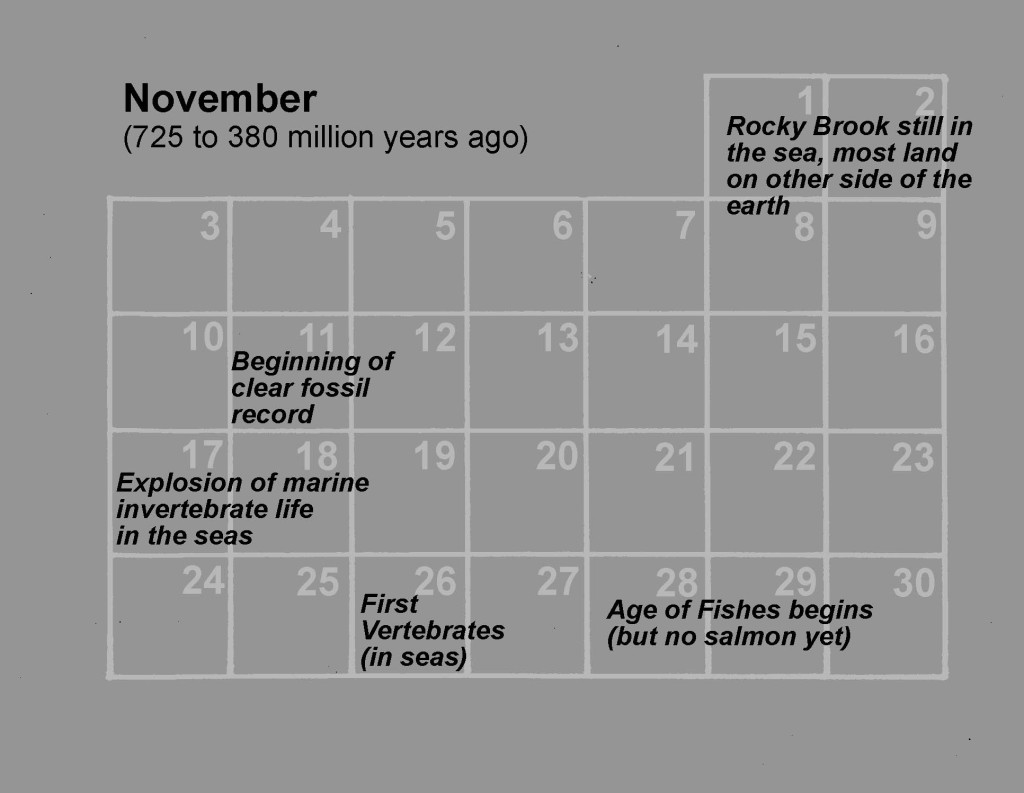
From our human perspective, things now really begin to change, and to change relatively fast (taking millions rather than billions of years). A good way to understand this is by seeing the month’s individual days (each representing about 12.5 million years in this scheme).
About 700 million years ago the planet’s primary land mass, called Rodinia, began to drift and break apart. Along its western margin, Laurentia was forming, the precursor to North America. These were geographically far to the east, around where northern Europe is now found, but slowly it drifted westward on molten magma. These precursors of the continents were comprised of much “lighter” material than the magma below, so they “floated” on it, moving around through complex and ever changing internal forces.
Rocky Brook was underwater at this time, part of the great ocean which eventually became the Pacific, but it too was located on a submerged floating plate. The rock surface which was at the geographic location of today’s Rocky Brook has long since gone elsewhere, probably towards Australia.
Around 600 million years ago, the fossil record begins to clearly exhibit the explosion of life that his happening in the seas. Around 500 million years ago marine invertebrates (more complex animals but still without backbones) appear. In another hundred million years, marine vertebrates (much more complex animals with backbones) appear, setting the stage for the great Age of Fishes (400 to 350 million years ago). These were largely warm water creatures, in warm oceans and seas, precursors of salmon though it would take another 250 million years before any fishes recognized as salmon appear.
We are still millions of years before dinosaurs appear.
December (about 375 million years ago to present)
Things Really Begin To Happen

December was a really busy month. From a human perspective, a lot happened in the last 350 million years of the earth’s history.
By the beginning of the month, 350 mya (million years ago), The Age of Fishes was ending, and the first tetrapods (the progenitors of all reptiles, birds and mammals) began to move from water to land. The pioneers were amphibians, but creatures which could take advantage of the increased oxygen in the atmosphere as well as all the plant life that had taken over the land quickly blossomed into myriad animal forms. Much of this was happening on the other side of the world from Rocky Brook, on the supercontinent Rodinia (also called Pangaea). It continued to fracture, break apart and drift towards more familiar locations.


By the middle of the month (175 mya) Laurentia, which was to become North America, breaks off and begins its long journey westward. This is also the time of the giant reptiles on land, such as the dinosaurs. They dominated terrestrial environments until about 63 mya when they became extinct due to what is believed to be the aftermath of a giant meteor crashing into the area around the Gulf of Mexico, resulting in huge firestorms and ash in the atmosphere, making life on land nearly impossible for years. This seems to be the most widely held belief, though the scientific community still debates whether it could have also been the result of increased volcanic activity or gradual climate change.
From December 15 to 25th, (periods commonly referred to as Triassic, Jurassic, and Cretaceous) trout like fishes inhabited cool and cold fresh water habitats.
In our analogy of comparing the earth’s history to a year, much of what interests us humans today happened in the last 60 million years, the last five days in our year analogy.
Around 60 mya (Dec. 27, after the age of the great dinosaurs) early mammals appeared. Also most of the Pacific Northwest land masses were in place, but they (including Rocky Brook) were still underwater. The fossil record includes a small freshwater fish, Eosalmon driftwoodensis, (considered to be a progenitor of today’s salmon and trout), living 50 mya.

Around 40 mya (Dec. 28) undersea volcanoes begin to build up the surface, forming the basis of what would become the Olympics, Cascades and Coast Range.
Around 25 mya (Dec.30), salmon as we know them appear (based on scanty fossil evidence).
And, in the last 12 million years (December 31), so much happens that we have to break it up into a 24 hour day to appreciate the order of things. Here every hour is about .5 million years.
From 2 to 9 pm (five to 1.8 million years ago), the Columbia, Fraser, Stikine, Nass and other major salmon producing rivers were in their present channels/locations, and most likely had runs of salmon.
About two minutes to midnight (around 18,000 years ago), the last big event happened which created present day Rocky Brook. Glaciers came down from British Columbia reaching as far south as Olympia. Sea level was 300 ft. lower, so Rocky Brook was much further from the sea. The significant depth of Hood Canal was gouged out by the glacier. For hundreds of years Rocky Brook was under ice (from both the continental glacier and the valley glacier coming down the Dosewallips. For a while the glacier forced rivers to flow south, emptying into the Chehalis river system, meeting the ocean around Aberdeen/Hoquiem. Salmon spawning was confined to the south, beyond the end of the glacier.
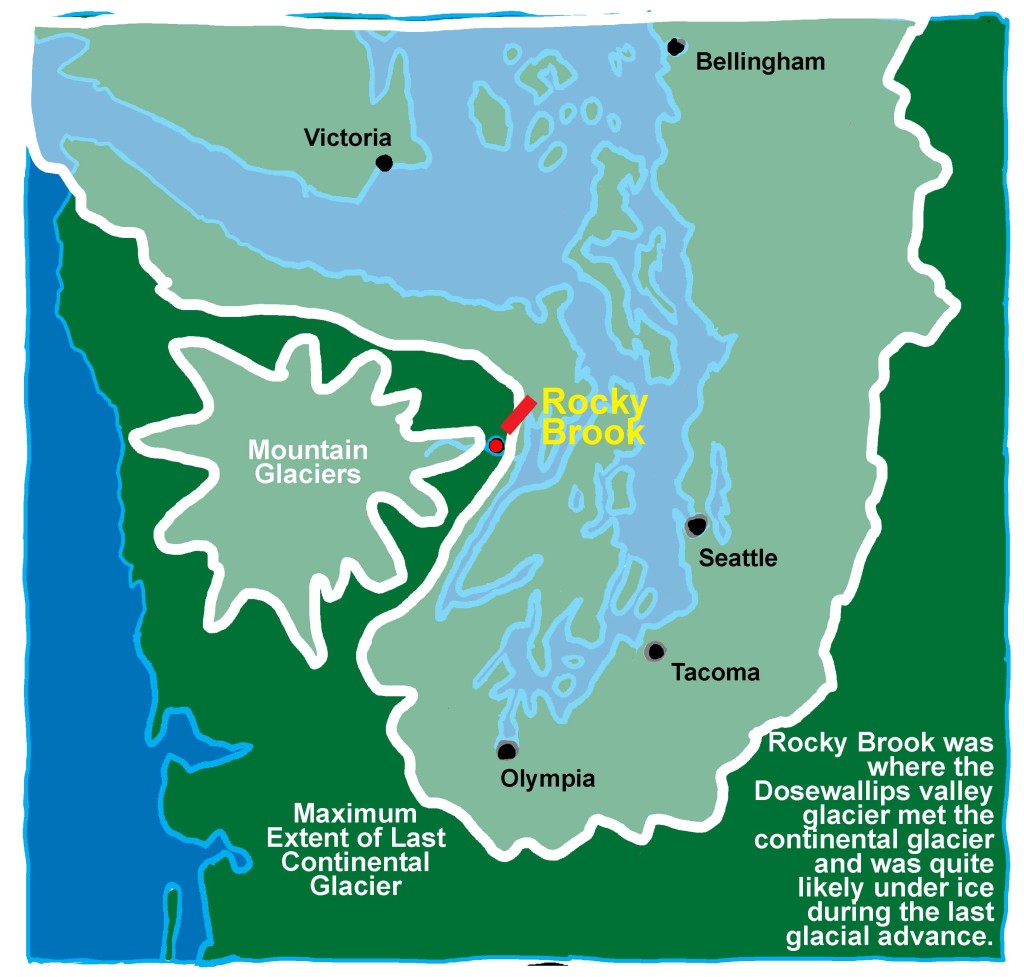
The glaciers began to recede around around 14,000 years ago (about 11:58 pm). Rocky Brook Falls appeared.
Humans crossed Bering Land Bridge from Asia, beginning to populate the Americas (about 11:59 p.m.).
At less than one second before midnight, I drove up to a little clearing along Rocky Brook in my 1970 VW Dormobile van, fell in love with the place, and the rest is (pretty recent) history.
I plan to write about my nearly 25 years living here (“My Time”) as well as the longer time of humans living around here (“Human Time”) in future blogs. Stay tuned as they used to say (but don’t sit by your computer waiting for them to appear, this blog took me nearly five months longer than I had anticipated).
My next blog (watch for it around March 1) will be called “How To Fix a River”.
Dennis Lloyd Kuklok
Rocky Brook, January, 2024
 allsalmonconsidered.com